What’s The Future Hold For WordPress Themes?
- •
- 11 min read
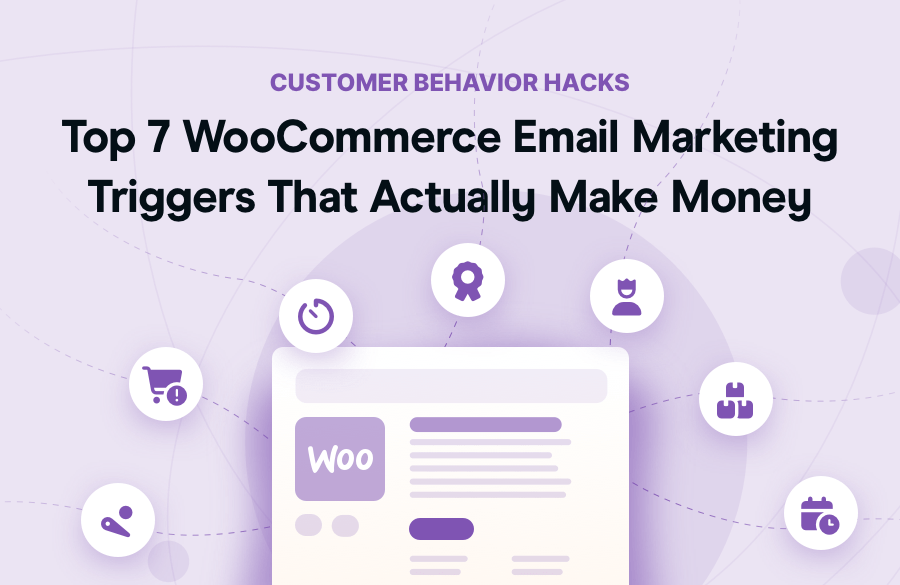
One of your WooCommerce clients sends the same “20% off” email to everyone. The person who bought it yesterday gets it. The VIP who’s spent $5,000 gets it. Someone who abandoned their cart 10 minutes ago gets it.
Result? 2.1% open rate. Maybe three sales.
Their competitor sends behavior-triggered emails that arrive exactly when customers want to buy. Those emails generate nearly 40% of their revenue.
What’s different? One blasts the same message to everyone. The other uses customer behavior and AI to make email feel personal. Push versus Pull marketing. Natch!
Back in 2023, we covered email marketing plays for WooCommerce. Now we’re going back to basics – with a twist. How do you use AI to automate emails based on what customers actually do?
Simple question. Powerful answer.
What you need to know: In 2024, automated emails drove 37% of all email-generated sales despite accounting for just 2% of email volume (Omnisend). That makes them about 15-20x more effective than regular emails.
The money: Email marketing generates $36 back for every $1 spent. For ecommerce, it’s even better — $68 per dollar in the US. (Litmus)
How AI helps: AI can easily figure out the best time to send each person an email. You can use AI to choose products that customers actually want. AI can write subject lines that get opened. And, they can do this automatically.
What triggers work:
Time needed: 15-25 hours to set up the basics for a typical store.
The tools: Klaviyo (for bigger stores), Omnisend (works for most), Drip (gives you lots of control), or FunnelKit (lives inside WordPress).
Results: The best email automations earn $16.96 per person. The best regular campaigns? Just $0.95 per person. emailmonday.com
“66.5% of online shoppers put items in their shopping carts but don’t buy them, according to one study. If you could recover just 10% of the revenue from those abandoned purchases simply by sending out an automated abandoned cart email, that might be the single most valuable email marketing you could create.”
woocommerce.com
So your client has 10,000 newsletter subscribers. Great!
They send everyone the same “New Product” email.
Result: Nobody opens your email. People unsubscribe. Your emails become noise.
Automated emails in 2024 drove 37% of sales from just 2% of sends.
Send smarter emails triggered by what people do.
Stop sending more. Start sending smarter.
Old email marketing sorted people by age and location is ancient history.
Smart email marketing watches what people do. What they click. What they buy. When they ignore you.
This data lets you send follow-up emails to customers who looked at products but didn’t buy.
You can use AI to take the data from your shop and turn it into automatic, personalized follow-ups. How?
Using Klaviyo, Omnisend, Mailchimp with the WooCommerce plugin, or Metorik + Engage, you can:
If someone looks at a product but doesn’t buy, AI can automatically:
This turns your raw WooCommerce shop data into smart reminders that increase sales.
“With the Klaviyo WooCommerce extension, you can take advantage of powerful tools, like high-converting email templates, customized triggers, A/B testing, cart reminders, and more. It syncs seamlessly with your online store so that you can truly personalize your email marketing.”
woocommerce.com
Someone spends 3 minutes on your product page. Zooms in on photos. Reads reviews. Then leaves without buying or adding to the cart.
Most stores? They do nothing.
After adding browse abandonment, you capture sales from people who never made it to the cart. Browse and cart abandonment together drive most automated orders.
Everyone knows about cart abandonment. Most get it wrong. Sometimes people put items in their cart so they don’t forget about them. Suggest that they make a wishlist instead.
Wrong way: Send immediately (creepy). Generic “You forgot!” message. No reason to come back.
Smart way:
Why it works: Cart abandonment emails get an average 50% open rate. That crushes regular promotional emails.
The customer buys something. Most stores send a receipt and vanish.
Bad move.
Someone buys a coffee machine? Send brewing tips right away. Offer some accessories that go with it.
These emails will get you a much higher opening rate than a standard customer newsletter.
Bonus: Let your favourite AI figure out which related products to recommend. No manual work.
Customer hasn’t bought in 90 days. Don’t send “We miss you!” with a random discount.
Segment by shopper type — send brand loyalists early access, give lapsed buyers discounts to come back.
This works really well with products that are consumable:
Sometimes customers forget when they purchased something. Make that one time impulse buy a subscription and suggest companion products. Not from your store? Set up an affiliate store and refer elsewhere.Attention is gold. (Oh, and don’t forget SMS reminders.)
Customer hits $1,000 lifetime value on their 4th purchase. Most stores treat them like everyone else.
That’s a mistake.
Businesses that personalize generate more revenue. Your best customers will stay your best customers — or become someone else’s. Your choice.
The customer wanted to buy something. It was sold out. They signed up for a notification.
Don’t just say “It’s back!” Let them buy now.
What works:
These convert like crazy because people already want to buy. You’re just removing the barrier. You know who does this well? Walmart. Check out their app sometime and think of them as an Enterprise Client. How can you upsell your clients with a better experience for their customers?
The customer bought coffee, vitamins, dog food, and maybe even a plugin. They’ll run out or need an upgrade eventually.
Try using AI to predict when, based on purchase date and product type.
Auto-remind them:
A pet store I know did this for dog food. Replenishment reminders became a huge revenue source in four months. Why? Convenience. Customers appreciate the reminder.
“The first email in your abandoned cart sequence should go out within an hour after abandonment, followed by additional reminders over the next two to three days. This timing strikes the perfect balance – not too immediate that customers feel pressured, yet not so delayed that they forget their intended purchase.”
Emercury
Don’t launch everything at once. Start with cart and browse abandonment — they make money immediately. These two plus welcome emails account for most automated orders.
Most stores discover they’re only using a fraction of available triggers. Usually just cart abandonment. Don’t be that store.
Use the platform’s templates. Don’t start from scratch. They’re built on data from millions of sends. Code smarter, work smarter.
Go deeper than “Hi [Name].” Reference their last purchase. Show products from categories they browse. Think about the last time you dated. Same.
Reminder: Don’t roll out all the automations at the same time. Begin with cart and browse-abandonment flows — they generate revenue right away.
Maybe. Good salespeople are persistent. Set frequency caps. If someone gets a cart email today, don’t send browse abandonment, too. Most platforms have rules like “Don’t send if they got another email in the last 24 hours.”
Watch your unsubscribe rates by workflow. If one causes problems, fix the timing or content. Getting the frequency right matters.
Start with behavior you can see: browsing, cart abandonment, and email clicks. This works even for new stores.
Add purchase-based segments as you collect data. Begin simple: “engaged vs not engaged” and “added to cart vs didn’t.”
Every day you wait is more lost data that could make your emails better.
Absolutely. Automation works 24/7 without hiring extra staff.
Averaged across industries, email makes $36 for every $1 spent. For ecommerce, it’s $68 per dollar. Smaller shops see between $5 and $15 returns.
Email is worth it regardless of the size of your business.
Every online store has customer behavior data. Most ignore it.
Winners use automation to respond to what customers actually do: browse, abandon, buy, ignore, return.
You need three things:
Stop using email like a megaphone. Make it feel like a conversation that responds automatically.
25%-35% of ecommerce revenue comes from email. How much of that are you leaving on the table?
Online shops setting up behavior-triggered automation are building real advantages for clients. The ones still blasting everyone? They’re watching open rates drop.
One approach has AI and customer behavior working for you constantly. The other has you scheduling the same email to everyone and crossing your fingers.
Pick your battlefield.
Top 5 Reasons Why You Might Want to Start An Affiliate Program
Affiliate programs beat fake AIO or other SEO hacks any day of the week. So, what do you need to know to start one?
Agency Communication Guide for Clients That Need ‘Simple‘ Changes
Everyone has experienced the classic, Friday afternoon, ‘Just add a button,’ right? Follow our agency communication guide: managing simple changes for your clients.
Rocket.net’s infrastructure means faster connections to email platforms, smooth data syncing, and reliable webhook delivery. Your automation needs instant data – we deliver it.
Grow your business with lightning-fast, secure, and optimized websites that are easy to set up & manage. Top-tier agencies and online businesses choose Rocket.net as their trusted managed WordPress hosting provider – why shouldn’t you, too?