What’s The Future Hold For WordPress Themes?
- •
- 11 min read
Most WordPress site owners — yes, even us — can obsess over the wrong things when their rankings drop.
They tweak meta descriptions. They add keywords. They swap plugins. They overchunk for AI. But they never look at the one thing silently killing their Google visibility: their hosting.
Your host decides how fast your server responds, how globally your content gets delivered, and whether real users — the kind Google and Bing actually measure — have a smooth experience or a frustrating one. All of that feeds directly into Core Web Vitals. And Core Web Vitals feed directly into your rankings.
This guide breaks it all down. What the metrics mean. How hosting shapes them. And what you can do — right now — to stop leaving rankings on the table.
Core Web Vitals (CWV) are three performance metrics Google uses to measure how users actually experience your website — not in a lab (like Lighthouse), but in the real world, on real devices, with real connections.
As Google’s Search Central documentation puts it: “Core Web Vitals is a set of metrics that measure real-world user experience for loading performance, interactivity, and visual stability of the page.”
They became an official ranking factor in June 2021. Since then, they’ve been baked into Google’s Page Experience signals — and Google has said clearly that its “core ranking systems seek to reward” pages that score well.
Google’s own John Mueller has been straight about it — relevance is still the dominant ranking factor. CWVs won’t rescue thin content, and a perfect performance score alone won’t push a weak page to position one. What they will do is give a well-optimized site a measurable edge over a competitor with equally strong content but slow infrastructure.
In competitive niches — and most niches are competitive — that edge matters a lot.
And, we are talking mobile loading times. That’s where you need to focus.
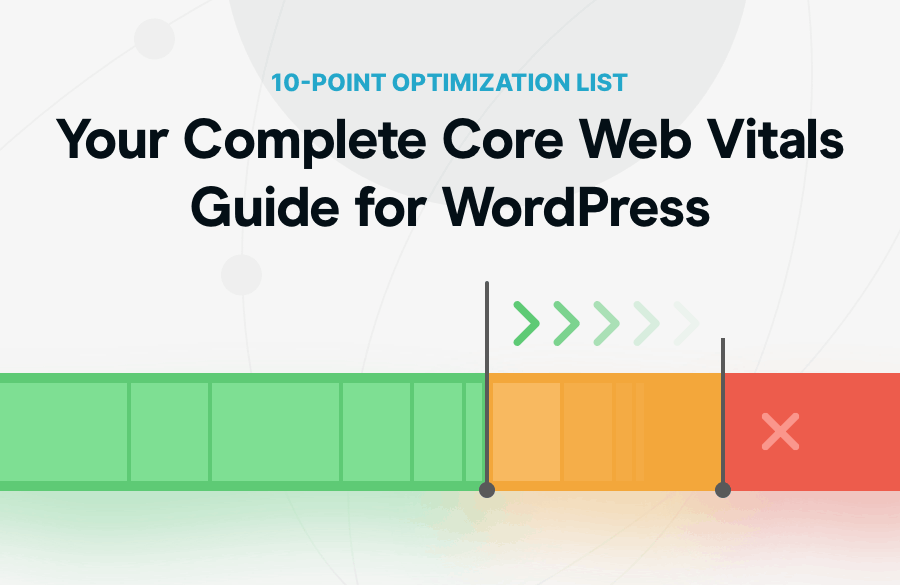
Google evaluates all three based on the 75th percentile of real Chrome user sessions — meaning 75% of your page loads need to hit “Good” to earn that status. That’s a demanding bar.
As of July 2025, only 43% of WordPress sites on mobile pass all three Core Web Vitals tests — meaning more than half are giving visitors a poor experience. (Source: searchengineland.com)
That stat should get your attention. WordPress powers over 40% of the web. It’s not inherently slow. But its open architecture — themes, page builders, plugin stacks — creates a performance minefield that shared hosting environments aren’t built to navigate.
The opportunity? If your competitors haven’t fixed this, you can leapfrog them by doing so. If more than half of websites are failing CWV, fixing yours gives you a competitive advantage.
Time to First Byte (TTFB) is how long your server takes to respond after a browser sends a request. It’s not officially a Core Web Vital, but it’s the foundation everything else builds on. A slow TTFB creates a slow LCP. Always.
Google’s threshold for “Good” TTFB is under 800ms. Under 200ms is excellent. Managed WordPress hosting platforms typically achieve TTFB of 100–200ms. Budget shared hosting commonly delivers TTFB between 400–800ms, consuming 16–32% of your total LCP budget before the browser has even received the first byte of HTML.
That gap doesn’t close with plugins.
The way managed hosting closes it is through server-level page caching. On shared hosts, every page load fires up PHP, queries the MySQL database, and assembles an HTML response from scratch. On a well-configured managed platform, a cached version of your page is served directly — no PHP execution, no database queries. The response is nearly instant.
At Rocket.net, this is handled through Cloudflare Enterprise Edge Caching, meaning cached pages are served from whichever of Rocket.net’s global Points of Presence is physically closest to your visitor.
If your web hosting server takes 1.5 seconds just to process the request (Time to First Byte), you only have 1 second left for the browser to actually download and paint the image. Most budget hosting options fail at this stage.
INP is mostly a client-side metric. It’s affected by JavaScript bloat, main thread congestion, and render-blocking scripts. Your caching plugin handles a lot of that.
But here’s what gets overlooked: INP also responds to server-side delay. Every interaction that requires a round-trip to your server — “Add to Cart,” “Submit Form,” “Apply Filter” — inherits your server’s processing time.
Cumulative Layout Shift is driven by application-level decisions: images without defined dimensions, late-loading fonts, and dynamically injected content that pushes existing elements around the page.
Hosting doesn’t cause CLS. But a well-structured managed platform does two things that make CLS easier to fix:
First, the speed of your server means assets load in a more predictable sequence, reducing the race conditions that often cause unexpected layout shifts.
Second, a well-managed host includes tooling that handles things like adding missing image dimensions and controlling how JavaScript loads.
A CDN is only as good as its coverage. Basic CDNs have 30–50 Points of Presence. That’s fine if your audience is concentrated in one region. It’s not fine if they’re spread across the globe — because Google’s CWV data is collected from real users in real locations, and a slow experience in Jakarta counts just as much as a fast one in New York.
Better Core Web Vitals scores mean better rankings. But they also directly affect your bottom line in ways that compound whether your rankings move or not.
In a study conducted by Google and Deloitte, a 0.1-second improvement in mobile site speed led to retail conversion increases of 8.4% and average order value increases of 9.2%. Travel sites saw conversion improvements of 10.1%. Lead generation sites saw bounce rates drop by 8.3%.
One tenth of a second. Barely perceptible to a human. Measurable in revenue.
Research confirms that a 1-second delay can reduce conversions by up to 7%, and 53% of mobile users abandon pages that take over 3 seconds to load.
For WooCommerce stores, these numbers aren’t abstract. A store converting at 2% that improves its site speed enough to shift to 2.2% is generating 10% more revenue from the same traffic. No new ads. No new content. Just a faster server.
“Performance isn’t just about speed – it’s about consistency, scalability, and reliability under pressure.”
Rocket.net- Key Considerations: WordPress Hosting for Digital Agencies
Not all hosting is equal, and “managed WordPress hosting” doesn’t mean much without specifics. Here’s what separates real performance hosting from marketing language.
TTFB is unpredictable, often exceeding 800ms. There’s typically no server-level caching, and no CDN is included. Fine for a hobby site. A liability for any site you care about ranking.
Mid-range cloud hosting gives you a dedicated cloud VPS, better resource allocation, and more configuration control. CDN and caching usually require add-ons. Performance is solid, but the responsibility for configuration sits more with you.
Managed WordPress hosting like Rocket.net is built specifically to solve the performance problems above:
The TTFB difference alone- – 100–200ms on managed hosting versus 400–800ms+ on shared — is the single biggest performance lever available to most WordPress sites.
“The result (of shared hosting) is slow loading websites… or server failures.”
Rocket.net – Why Rocket.net Will NEVER Be Commodity Hosting
Managed hosting handles the infrastructure layer. But to get to green across all three Core Web Vitals consistently, you also need to clean up the application layer — the WordPress side of things.
This is why Rocket.net’s approach is described as a “dual-layered” strategy: managed hosting for the backend, WP Rocket plugin for the frontend — moving from “optimizing for speed” to “optimizing for stability.”
WP Rocket ships FREE with Starter, Pro, and Enterprise plans. It helps handle what the server can’t in some instances:
WP Rocket delivers results out of the box, with 80% of web performance best practices applied right upon activation. For non-technical users, that’s the difference between needing a developer and handling it yourself in under ten minutes.
Seeing substantial gains in key metrics like Largest Contentful Paint (LCP) and Interaction to Next Paint (INP) means your website looks a lot better to search engines. Your visitors will also thank you for the quick-loading site.
“The more plugins you have, the more resources your site requires to load.”
Rocket.net – How Many WordPress Plugins is Too Much?
Hosting is the foundation. But what you build on top of it matters, too. Your theme and plugin choices can easily undo the performance gains a great host delivers — or amplify them.
Not all WordPress themes are built with performance in mind. Many popular themes — particularly those bundled with their own drag-and-drop builders — load hundreds of kilobytes of CSS and JavaScript on every page, whether you use those features or not. That bloat hits LCP and INP directly.
Lightweight themes like GeneratePress, Astra, and Kadence are built differently. They load minimal CSS by default, add features only where needed, and are architecturally designed to score well on Core Web Vitals. On the same hosting infrastructure, a site running GeneratePress will routinely outperform an identical site running a bloated theme — sometimes by a full second on LCP.
The rule of thumb: if your theme ships with its own page builder, visual composer, or “theme options” panel that generates inline CSS, benchmark it carefully before committing. A theme’s demo score in a controlled environment rarely reflects real-world performance with your content and plugins.
Every active plugin adds PHP execution time, database queries, and often CSS and JavaScript to your pages. Most plugins are worth that cost. Many aren’t.
The plugin categories most likely to hurt Core Web Vitals are:
| Plugin Category | CWV Impact | What to Do |
| Sliders & carousels | LCP, CLS | Replace with static hero images where possible. |
| Live chat widgets | INP, LCP | Load via façade or on user interaction only. |
| Social media feeds | LCP, CLS | Self-host or lazy load; avoid auto-refreshing embeds. |
| Page builders | LCP, INP | Use lightweight builders or a block editor; purge unused CSS. |
| Tracking & analytics | INP | Defer scripts; use server-side tracking where possible. |
| Backup plugins | TTFB (on backup runs) | Schedule backups during off-peak hours. |
| Upsell/pop-up plugins | CLS, INP | Trigger only on interaction; reserve layout space. |
WooCommerce sites – like any shop system — face a compounded challenge. Cart pages, checkout, and account areas can’t be fully cached — which means every interaction on those pages depends directly on server response time. This is where PHP workers, object caching (Redis – free with Rocket.net hosting), and a host built for dynamic WordPress traffic make or break the experience.
Common WooCommerce plugin culprits for CWV failures include product filter plugins that inject JavaScript on every page, review and loyalty plugins that load third-party scripts globally, and payment gateway scripts that aren’t deferred. The fix is usually scope control: load each plugin’s assets only on the pages that need them, using a tool like Perfmatters.
The bottom line on themes and plugins: your hosting sets the ceiling for performance. Your theme and plugins determine whether you hit it.
Work through these in order. The highest-impact changes come first.
Open Google PageSpeed Insights and run your homepage, your top three landing pages, and your most important product or blog pages. Record your LCP, INP, CLS, and TTFB values. Then open Google Search Console > Experience > Core Web Vitals. This is the field data Google actually uses for rankings — treat it as your north star.
If your TTFB is above 600ms, you have a hosting problem. No plugin will fix it. Review whether your host provides server-level or edge caching, a quality CDN, and isolated resources. If it doesn’t, consider migrating. Rocket.net’s team handles migrations free of charge, typically completing them within 60 minutes.
If you’re on managed hosting, server-level caching is typically on by default. If you’re on shared or cloud hosting, a caching plugin is your next best option. WP Rocket is the most complete solution that’s free here, LiteSpeed Cache is a strong free alternative for LiteSpeed server environments.
“Website speed and experience are two very different things.”
Rocket.net – Rocket Still Recommends Caching Plugins – Though It’s Really About Optimization
If your host includes a CDN, confirm it’s active and serving your pages — not just your static assets. If there’s no CDN included, Cloudflare’s free tier is a significant step up from nothing and can be added to any site in minutes.
Images cause more LCP failures than anything else after TTFB. Convert everything to WebP or AVIF. Compress images before uploading. Add explicit width and height attributes to every image to prevent layout shifts. Make sure your LCP element — the hero image at the top of your page — is NOT lazy-loaded. It should load immediately.
Unused or render-blocking JavaScript is the primary driver of poor INP. Delay non-critical JS where possible. Audit and remove third-party scripts you don’t need — analytics, chat widgets, ad tags, and social sharing buttons can each add 100–300ms to your INP. Every script that runs on your page is a potential delay on every interaction.
Late-loading ads, embedded videos, and web fonts that aren’t preloaded cause layout shifts. Specify dimensions on all media. Use aspect-ratio in CSS for responsive elements. For web fonts, use font-display: swap to prevent invisible text during loading, and preload your key fonts in the <head>.
For WooCommerce stores and membership sites where many requests can’t be served from cache, object caching stores database query results in memory so they don’t re-execute on every request. Redis and Memcached are the standard solutions. Most premium managed hosts either include object caching or support it as an add-on.
Every plugin that loads scripts and styles on every page adds PHP execution time and HTTP requests. Audit your active plugins. Deactivate anything unused. For plugins that are needed but load too broadly, Perfmatters lets you disable scripts on a per-page basis — so your contact form plugin only loads on your contact page, not your homepage.
Core Web Vitals are measured on a 28-day rolling window. Changes you make today won’t appear in Search Console for up to four weeks. Keep monitoring. Set a monthly reminder to check your Core Web Vitals report in Search Console. Performance degrades as plugins update, new content is added, and third-party scripts accumulate.
Google Search Console (Core Web Vitals report): Your primary reference. Real user data. The numbers Google uses for rankings. Updated every 28 days.
Google PageSpeed Insights: Combines CrUX field data with a Lighthouse lab audit. Gives both your real-world scores and specific recommendations. Always check mobile separately — Google uses mobile data for mobile rankings.
GTmetrix: Excellent waterfall charts. Shows exactly which resources are slowing your page and in what sequence. Useful for diagnosing specific issues before and after changes.
WebPageTest: More granular than GTmetrix. Lets you test from specific global locations – useful for verifying your CDN is working correctly for international visitors.
Chrome DevTools: The most detailed tool available, and it’s free. The Performance tab shows a precise timeline of page rendering. The Coverage tool identifies unused CSS and JavaScript.
| Metric | Good | Needs Improvement | Poor |
| Largest Contentful Paint (LCP) | ≤ 2.5s | 2.5s – 4.0s | > 4.0s |
| Interaction to Next Paint (INP) | ≤ 200ms | 200ms – 500ms | > 500ms |
| Cumulative Layout Shift (CLS) | ≤ 0.1 | 0.1 – 0.25 | > 0.25 |
| Time to First Byte (TTFB) | ≤ 800ms | 800ms – 1800ms | > 1800ms |
Google scores your site at the 75th percentile of real user sessions — 75% of page loads must hit the “Good” threshold.
Many WordPress site owners treat hosting as a commodity. Pay as little as possible, set it and forget it. That mindset is costing them rankings, conversions, and revenue they don’t even know they’re losing.
Core Web Vitals made hosting a measurable, rankable factor. Your TTFB is now a ranking input. Your CDN coverage is a ranking input. Your server’s ability to handle concurrent requests without slowing down is a ranking input.
The good news: this is fixable. And when you fix the infrastructure layer first – fast TTFB, edge caching with a global CDN – everything else gets easier. Plugins work better. Image optimization has more room to breathe. JavaScript deferral has a faster baseline to work from.
The most successful SEO strategies aren’t about chasing algorithms. They’re about building a strong technical foundation and creating content that serves your audience’s needs.
Start with the foundation. Measure everything. Then optimize the details.
Grow your business with lightning-fast, secure, and optimized websites that are easy to set up & manage. Top-tier agencies and online businesses choose Rocket.net as their trusted managed WordPress hosting provider – why shouldn’t you, too?