What’s The Future Hold For WordPress Themes?
- •
- 11 min read

Regardless of what you may have read, SEO is still here and is still just about one thing: getting found by people who do not know your name.
Sure, there is now AI in the building, but not so long ago mobile websites were the game changer. Before that there were fax machines, which followed pagers.
Despite the latest shiny new thing, here we are still doing SEO. Getting found is getting found – the players may have changed, but the game remains the same.
Here’s what has changed: AI doesn’t care, among other things, about your keyword density anymore. It cares about whether you actually solve someone’s real problem. This, to most of us doing SEO, didn’t really require waiting on machine learning to make clear.
Real Problems. Real Answers.
Think about it. When you ask ChatGPT or Google, or Perplexity something, you don’t just type “dog food.” You say “What’s good dog food for a picky eater that won’t break the bank?”
That’s the difference. You’re describing your actual situation — your real limits and needs.
And that’s exactly what (good SEO was always about) AI is looking for.
Remember English class? “Don’t write like you talk.” Well, forget that.
For Voice Search, Conversational SEO, and AI, you actually do want to write the way people speak. ChatGPT, Google’s AI, Bing — they all understand normal conversation better than fancy marketing speak.
Even super intelligence can’t figure out what you mean by “scope the vertical.” Just say “I don’t know” and save everyone’s time.
See the difference? Your content needs to match how real people ask questions.
Voice search and semantic search changed everything. People talk to their phones and assistants now. They ask full questions. If your content doesn’t sound natural, AI will skip right past you and find someone who gets it.
“Let’s go beyond just keywords. We have machines that interpret language in peculiar ways, and we know Google uses techniques to align content with user queries. But what comes after the basic keyword match? That’s where entities, neural matching, and advanced NLP techniques in today’s search engines come into play.”
searchengineland.com
Here’s where SEO is getting interesting. Old-school Google showed you ten blue links. New AI search? It just tells you the answer. Zero-Click Search like a boss!
ChatGPT and Google’s AI Overview don’t rank pages anymore either. They read a bunch of sites, pick out the good stuff, and create one answer. That means your content needs to be easy to understand and quote.
People are calling this GEO — Generative Engine Optimization. We say people, because if you ask AI what GEO is, it starts off talking about geography.
To make SEO really work, (and this isn’t totally new) you need:
So why does writing like a regular person work better?
Your grandma was wrong. You should write like you talk. Just clean it up a bit.
Old-school SEO was all about keywords: Find the magic phrase, use it a bunch of times, and win.
AI doesn’t play that game. AI stands on business.
When someone asks AI for help, they describe their actual situation:
Notice something? Each person just explained their real-life limits. That’s what AI uses to make recommendations.
If your content doesn’t talk about these real situations, AI will skip right past you.
Constraints Beat Keywords Every Time. That’s the takeaway.
Let’s keep this simple. Instead of chasing keywords, ask yourself:
Here’s how this looks in practice:
These aren’t keywords. These are real situations.
When you write for real situations instead of keywords:
Most sites still spam keywords. Writing for real people stands out. Ergo: less competition.
When you relate to a person’s exact situation, they feel understood and trust you more.
Listen where people complain:
Look at what people are spending money on:
Whatever keeps popping up? Where do people need help? What are people willing to pay for? That’s your content idea.
Enough theory. Let’s talk about what you should actually do. And, this works whether you run a tiny blog or a massive online store.
Forget short keywords. Use real questions people ask.
Instead of “Best Cat Litter Box,” try “What’s the Best Litter Box That Won’t Track Everywhere?”
Then answer it. Right away. Don’t make people hunt.
The second one sounds like a real person asking a real question.
Let’s say you’re writing about website hosting:
The second one speaks to someone’s exact worry. Someone who’s growing, watching costs, and scared of their site crashing.
That’s the person AI is trying to help. And if your content gets their situation, AI will recommend you.
“AI Mode cherry-picks the best, most extractable passages kind of like how reporters look for soundbites. Generic, fluffy, or poorly organized content? You’re out. Data-backed, original, and clearly structured? That’s what gets surfaced and cited.”
Rocket.net – What is Google AI Mode? Should I Be Worried About my SEO?
When someone searches now, AI doesn’t just look for exact words. It thinks about what they really want. Which is like Google’s semantic search on speed.
Semrush explains this as “query fan-out” – how AI systems break one question into several smaller queries, find answers to each, then combine them into one response. For instance, when someone asks “best limited-ingredient dog food for allergies,” the AI might actually search for hypoallergenic recommendations, single-protein brands, grain-free options, and foods without common allergens — then merge all that into one answer.
Let’s say someone searches: “What’s the best litter box that doesn’t track litter across the house?”
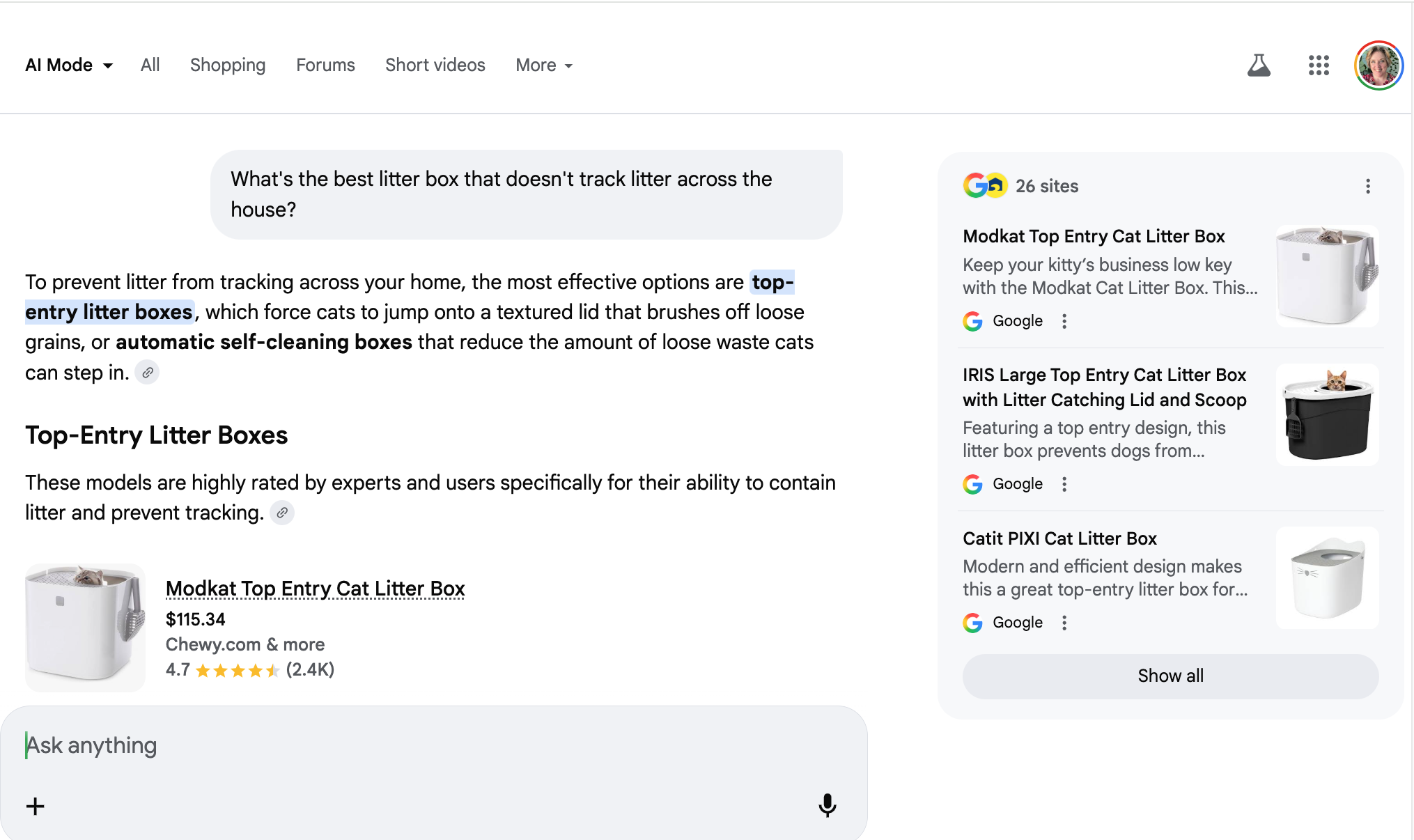
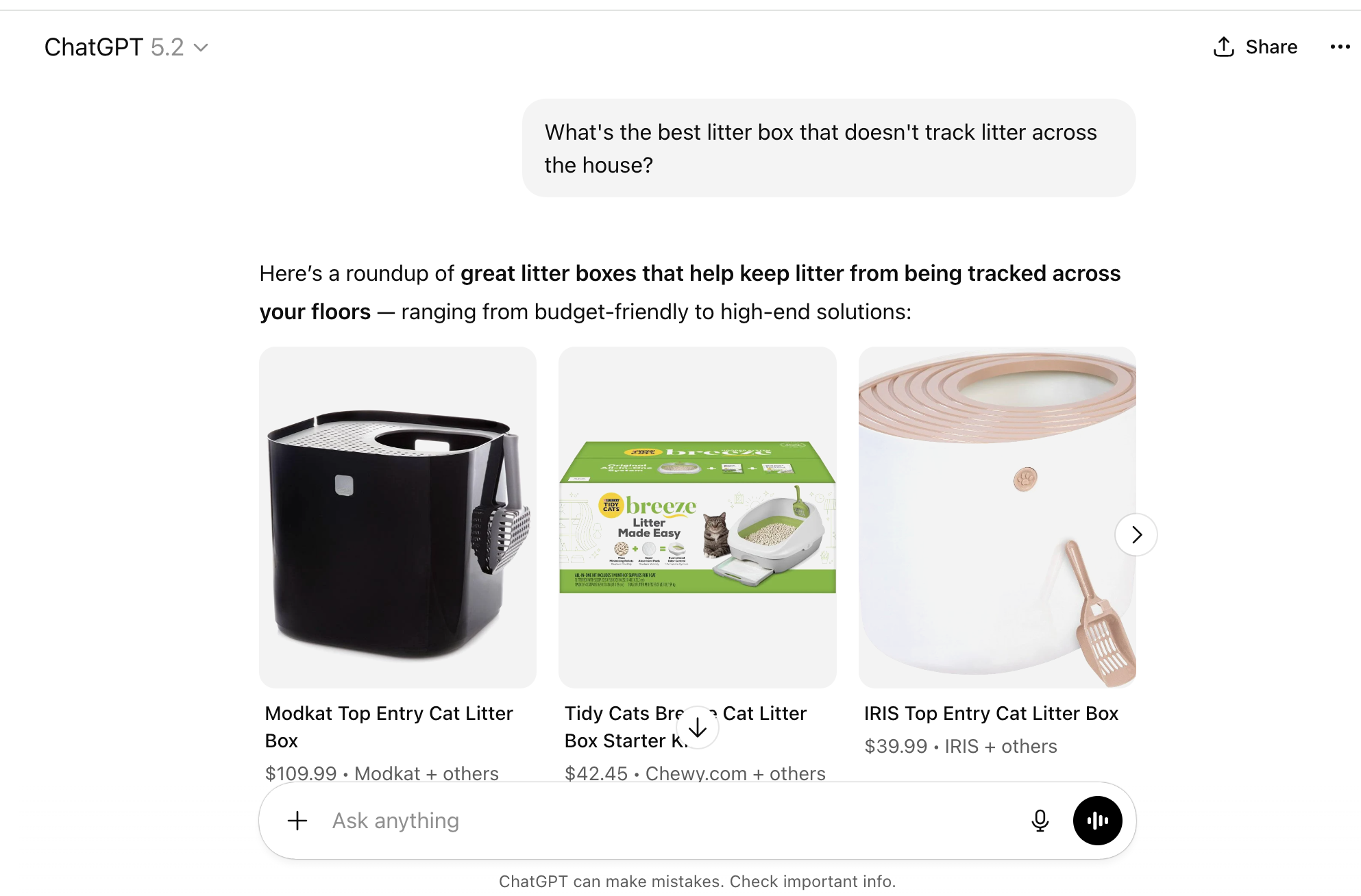
Here’s what AI does:
What this means for you:
You could write one good article about litter tracking problems. If you naturally talk about:
Then AI will show your article for many different searches. Not just the exact phrase.
Old SEO thinking: Go after “best litter box” – too competitive, too vague.
Smart new SEO thinking: Answer these instead:
Each one gets you:
When AI sees any of these searches, it can point to your article because you covered the topic like a helpful friend would – from all sides.
The big win: Write one really good post. Get found for dozens of searches. That’s how SEO works.
“At least 60% of search queries now end without a click. That means Google and AI tools like ChatGPT are answering users’ questions directly in the SERPs or through curated results. Users no longer need to visit a website to find the information they’re looking for.”
Rocket.net – 10 Off-Page SEO Strategies That (Still) Work
Sometimes AI just gives the answer, and no one clicks your link. It’s called “zero-click” and yeah, it’s nothing new, but with AI it’s even more annoying. It’s still visibility.
But you can still win:
Google and AI both care more about who you are than what keywords you use.
They still look for E-E-A-T (Experience, Expertise, Authoritativeness, Trustworthiness). Basically: Do you know what you’re talking about?
Show real experience. Share actual data. Be a human expert, not a content farm.
“GEO improves AI visibility, but it’s not a new concept. Fundamentally, if you’ve been investing in SEO, brand building, and content marketing, you’re already doing GEO. If you haven’t, now’s the time because it definitely matters for AI search.”
Lily Ray on moz.com
If your website, or your clients, use WordPress, tools like Rank Math or AIOSEO make this easier. Here’s what they do:
No plugin will magically get you to #1, but they will keep your site AI-friendly without you having to be a tech genius.
Tip 1: Figure out what your readers are actually worried about. Not what keywords they type. What keeps them up at night? What are they afraid of getting wrong?
Tip 2: Listen to real conversations happening in real time:
Tip 3: Make it easy for AI to quote you:
Don’t just let AI write it all. Sure, use AI to brainstorm ideas. But rewrite it in your own voice. Make it sound like you.
Tip 4: Then, track the new stuff that matters:
These matter more than being #1 for some random keyword.
SEO isn’t about stuffing keywords or using fancy words. SEO is (still) about understanding what someone needs help with.
You’re not Shakespeare either. Write like you’re helping a friend. Answer their actual question, including the parts they’re worried about but didn’t ask.
People don’t search for keywords. People search for solutions to actual problems.
So stop chasing keywords, and start solving real problems for real people with real limits on their time, money, or patience. AI will get you in front of them.
Grow your business with lightning-fast, secure, and optimized websites that are easy to set up & manage. Top-tier agencies and online businesses choose Rocket.net as their trusted managed WordPress hosting provider – why shouldn’t you, too?